A sphinx that prints your fortune. You walk up to a pyramid; a metre away, something decides it has a thing to tell you.
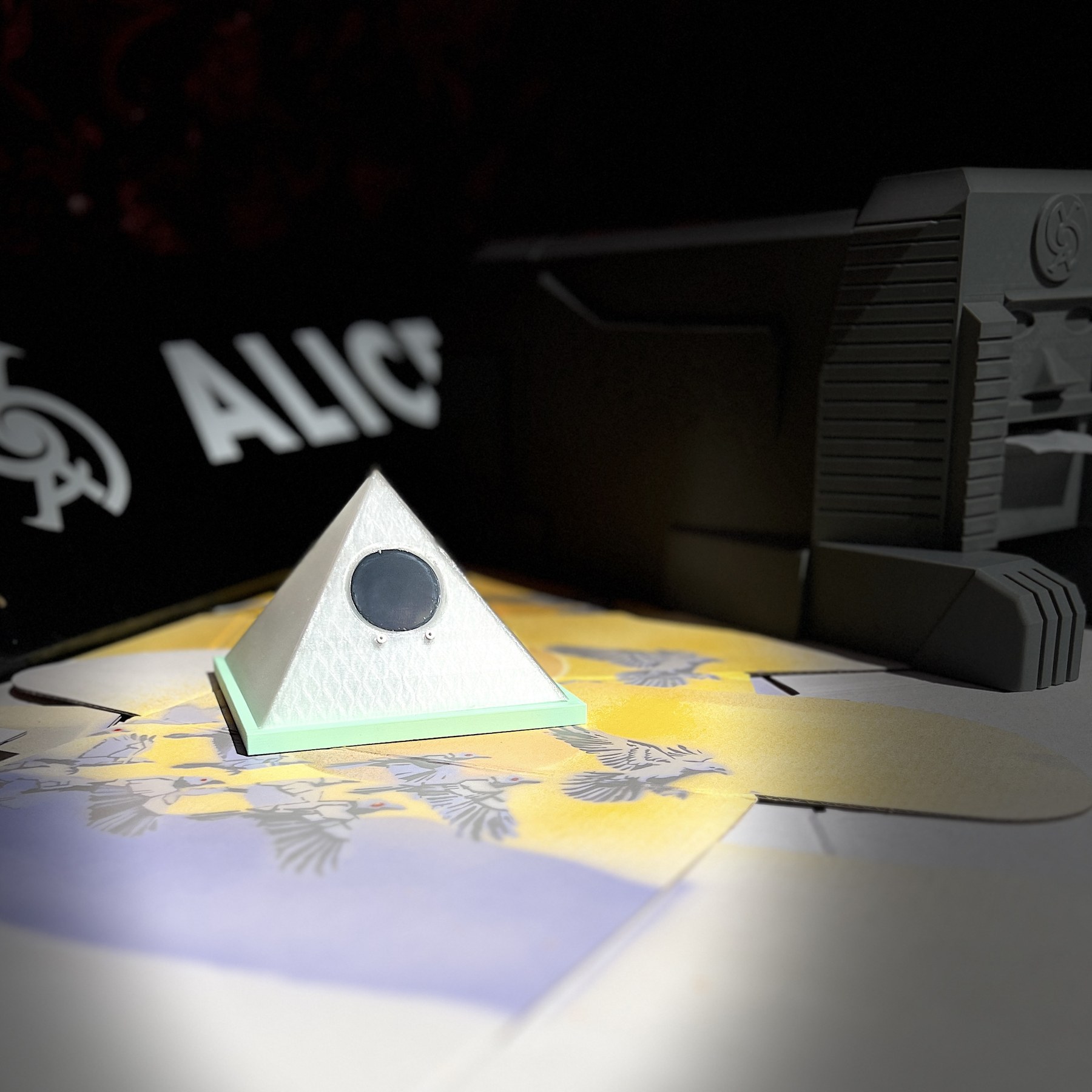
The pyramid is the part that notices you. A radar behind its face picks you up at about three feet and the eye shifts from blue to amber. Wave a hand through the beam, or press the button, and the pyramid flashes white and tells you your destiny has been written. Then, across the table, the sphinx wakes up and a ticket comes out of its mouth.
I will admit up front that a fortune-telling machine sits on the very short list of Things Every Maker Eventually Builds. I built one anyway. It turns out to be worth it: people take the ticket, read it, and then stand there holding it, which is more than most things I have made can claim.


Why two of them
The two halves are separate devices that talk to each other directly over ESP-NOW — no Wi-Fi, no router, nothing to join when I set up in a room I have never been in before. The pyramid holds the sensing and the display and stays cool and empty. The printer is a Zebra LP 2824 Plus, a beast and a fine vintage machine, and it gets its own box so it can be exactly as heavy and as particular as it wants to be.
The sphinx
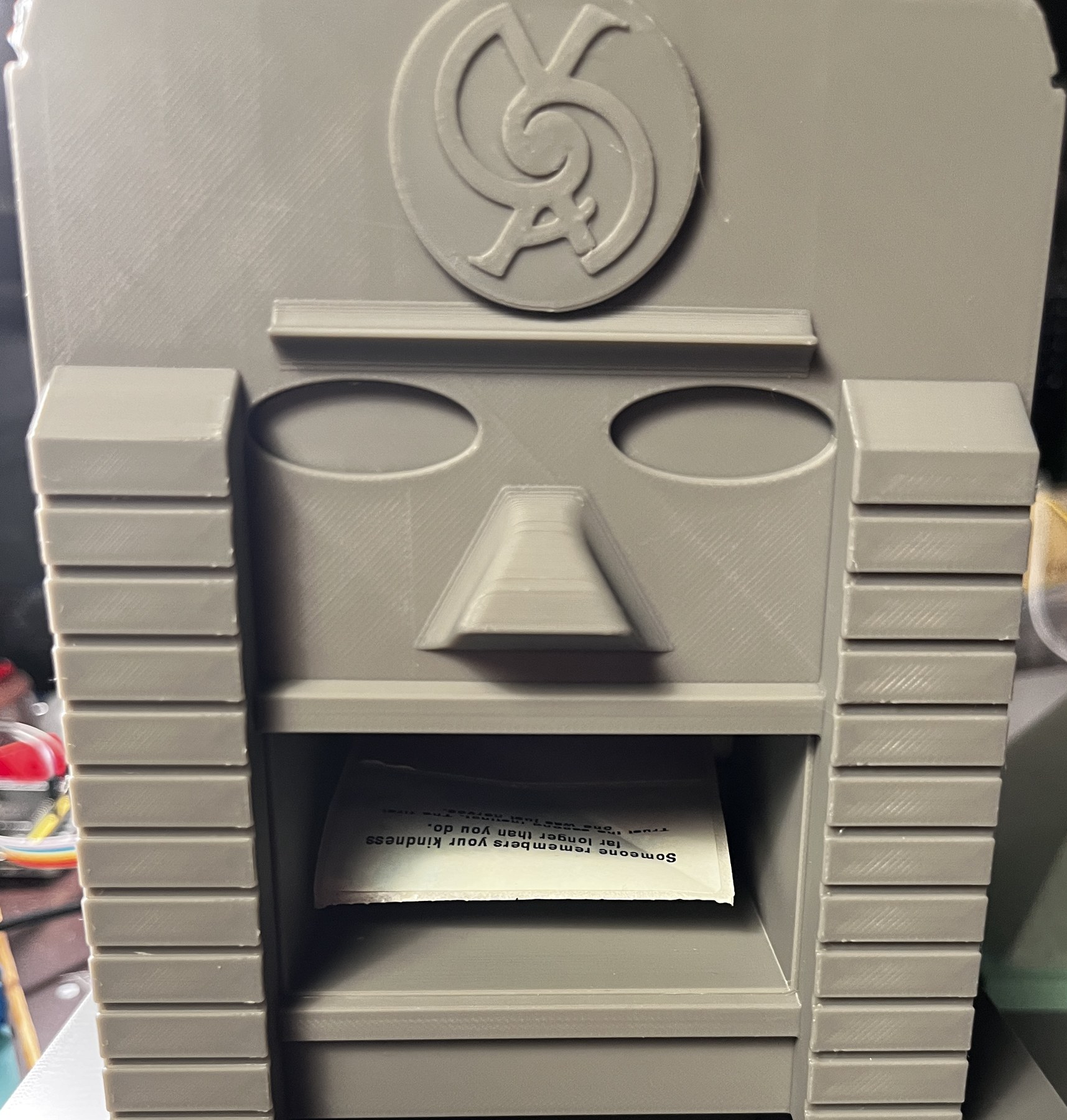
The enclosure is parametric — built in Onshape as a custom FeatureScript feature, so the whole animal regenerates when a dimension changes. Five printed parts, about 1.3 kg of silver PLA, head resting on its paws.
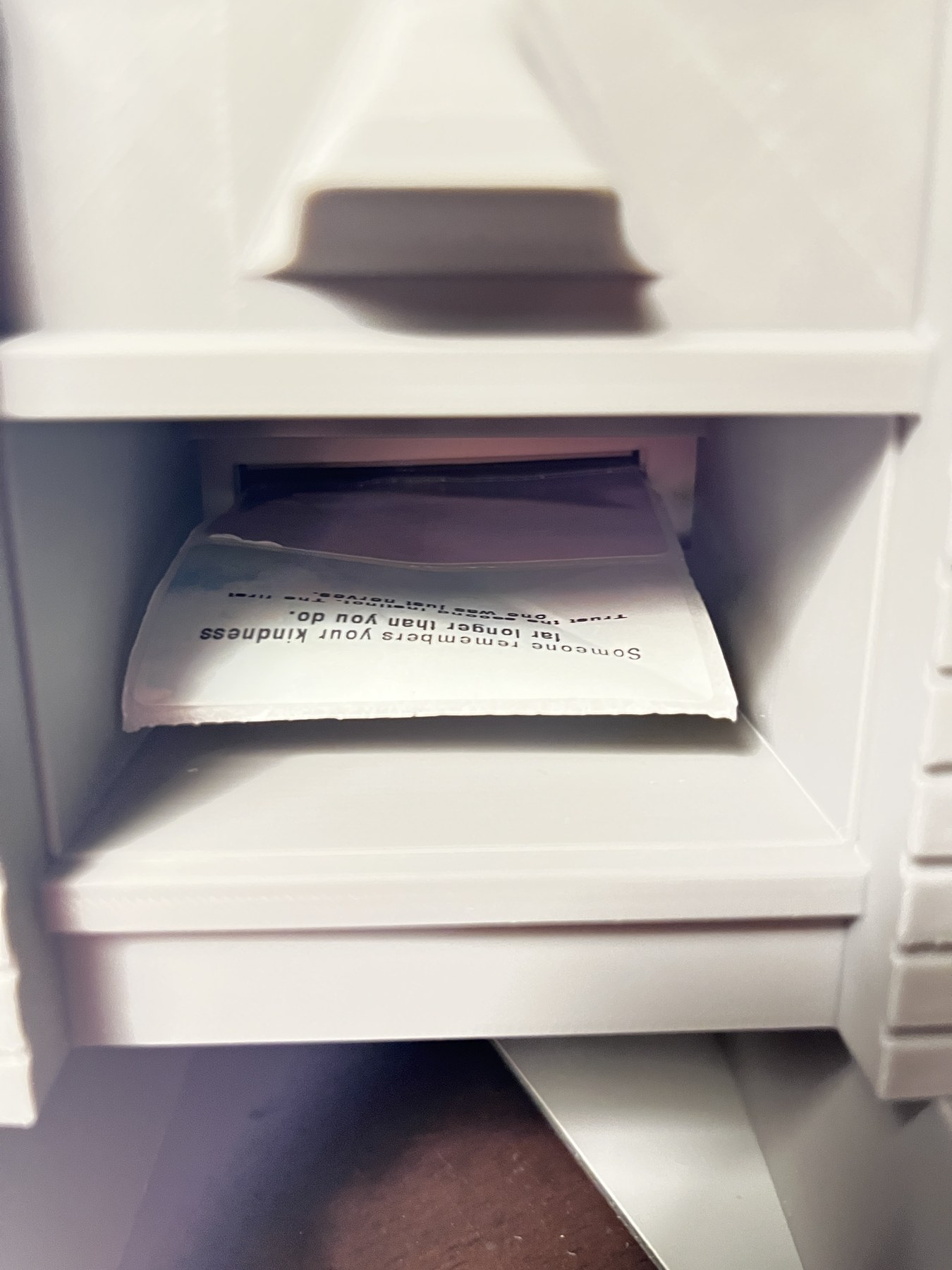
One rule drove the entire design: the fortune has to come out of the mouth. Everything else followed from that. The mouth had to be deep enough to hide the mechanism and shallow enough that a person could actually get their fingers to the paper. The tear strip sits in the lips so the serrated teeth land just above the ticket and a tear comes off clean — and when it does, the next ticket’s header is already printed and waiting between the teeth.
The honest eye
The display tells the truth about what just happened: printed, out of paper, sphinx not answering, still cooling down. It would have been easy to let it say something mystical and leave the person guessing. A machine that admits when it has failed is less magical and much better company.
There are 82 fortunes, shuffled so no one draws a repeat until the deck is spent. One of them reads: Someone remembers your kindness far longer than you do.
Built from
- 2 × ESP32-S3-WROOM-1 dev boards, linked by ESP-NOW
- GC9A01 1.28″ round SPI display — the eye
- HLK-LD2410C 24 GHz mmWave presence radar
- MAX3232 TTL-to-RS-232, into a Zebra LP 2824 Plus (203 dpi, ZPL II)
- 56 mm continuous thermal receipt roll
- ~1.3 kg silver PLA — sphinx in five parts, plus the pyramid
- Designed in Onshape with FeatureScript
Read the full build on Hackster →
The Oracle at Alice Vortex →
It debuted at Burque ByteFest in Albuquerque in September 2026, in a room full of software people and vintage-computer enthusiasts. The sphinx resting its head on its paws is what brought them over.
ESP32-S3 · mmWave radar · Zebra LP 2824 Plus · parametric 3D-printed enclosure · 2026